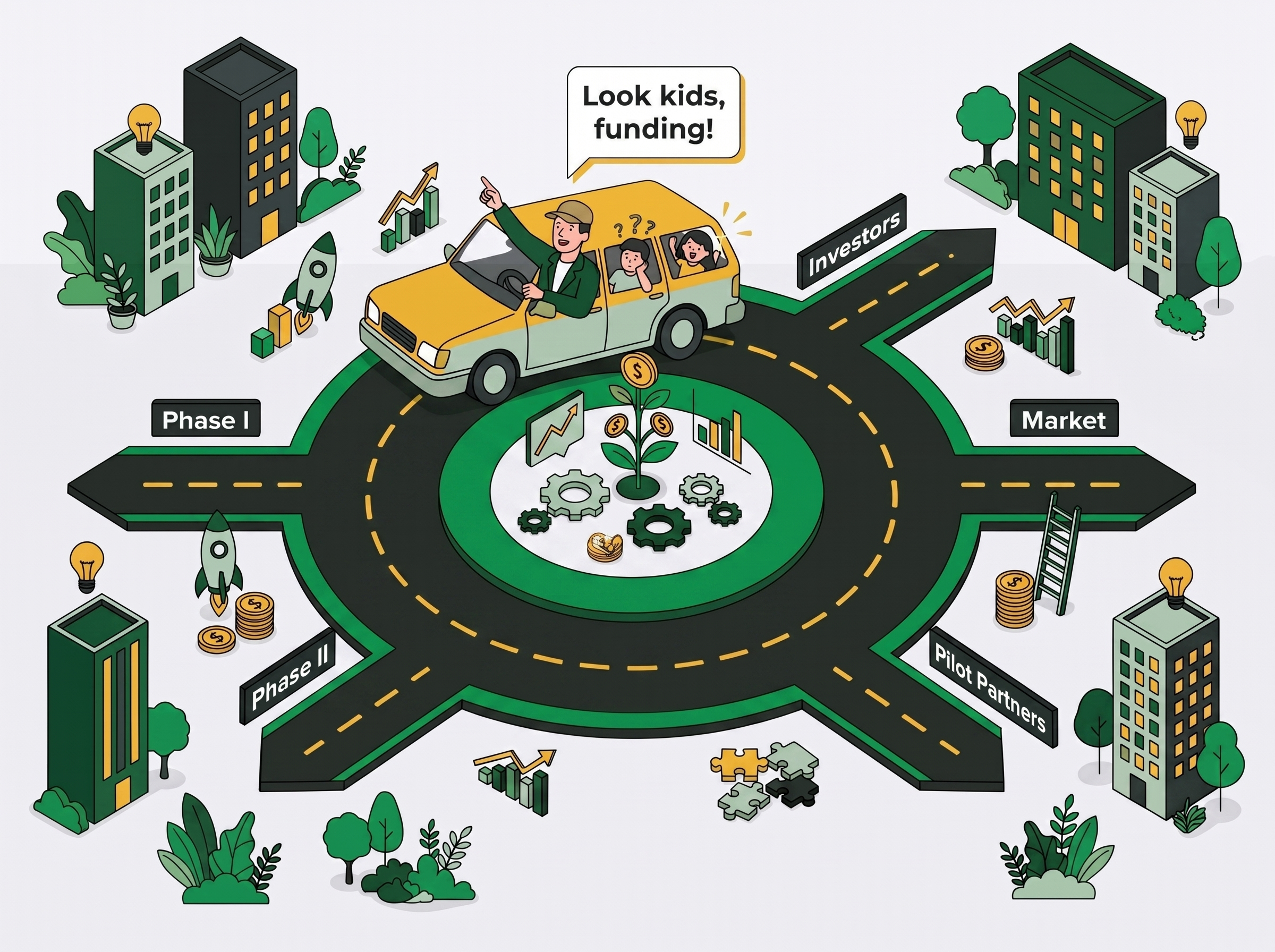
A Guide for Technology Startups & SBIR Founders

Push + Pull

Building a Resilient Commercialization Engine in the Modern Age of Technology Development

The funding environment has changed. The commercialization playbook hasn't. This guide is the system that closes the gap.

Read the Guide →
From Push to Pull — Catalyzing Concepts

Five Questions This Guide Answers

Most deep tech never reaches the market — not because the science is weak, but because the commercial infrastructure was never built. Commercialization is the bridge between what you’ve discovered and the impact it can create.

The system is built around push: grant applications, technical reports, conference presentations. Push creates presence — it doesn’t build commercial momentum. Every funding cycle resets the clock. Nothing compounds.

Add pull to your push. A parallel track focused on relationships, market presence, and a network that pulls your technology forward — changing the entire trajectory regardless of the funding cycle.

SBIR/STTR awardees, deep tech founders, and university spinouts navigating the valley of death between TRL and first revenue. If you’re technically credible but commercially invisible, this guide was written for you.

Through five key questions that define your messaging, a four-week sprint that builds the infrastructure, and a system that operates continuously — not just when a deadline forces the conversation.

The Exposure Event

To say funding for technology development took a hit over the last 12 months would be an understatement. It might even be an insult to understatements.

If we were more fortunate, we might have been given a quick and decisive end. Instead, we were given the long, slow unraveling of what had become the structural stalwart of research, development, and early-stage commercialization.

Delayed deadlines. Cancelled solicitations. Months of uncertainty. And ultimately, a system that many had built around simply stopped behaving like a reliable foundation.

As of this writing, key programs like SBIR still sit in limbo — passed, debated, delayed — while the technologies and teams that depend on them are left waiting.

What followed wasn't just a funding gap. It was an exposure event.

Because when the funding slowed down, something deeper became impossible to ignore: the way we pushed technology from lab to market wasn't really a system at all — but a singular path that moved at a glacial pace.

For decades, federal funding did more than provide capital. It served as validation. It signaled credibility. It acted as the connective tissue between universities, startups, investors, and industry partners.

Because it offered funding and something of a concrete path forward, we allowed it to become the system. But it was never a complete system.

Even at its best, it was slow. Competitive to the point of exclusion. Operationally heavy. In many cases, circular — where funding flowed in only to be consumed by the same ecosystem it came from, without ever fully translating into market-driven outcomes.

How many times did one agency give funding for it to be used at a lab run by another?

It created progress, but not momentum. And more importantly, it created dependency.

Without funding, validation slowed. Without validation, customers hesitated. Without customers, funding became even harder to secure. And so the cycle reinforced itself.

For those of us working in technology commercialization, this has been a precarious moment. Projects stalled. Timelines compressed. Paths forward became unclear.

But it has also been clarifying. Because it revealed something we likely knew, but hadn't fully confronted:

We were pushing innovation forward — but we hadn't built the systems to pull it into the market.

That's the shift this moment demands. Not abandoning what worked — but completing it. We need a system that preserves the strengths of the existing model while removing its fragility. One that allows universities, startups, investors, and industry to work together more efficiently. One that doesn't rely on a single source of validation or capital to function.

A system where innovation doesn't move forward only when pushed — but is also pulled forward by real demand, real relationships, and real market signals.

Because when that exists, funding becomes what it was always meant to be: a catalyst. Not the foundation.

This is the idea behind Catalyzing Concepts — a new approach to technology commercialization designed to build that system. We work with startups across hardware, medtech, advanced materials, energy, and climate technology — founders navigating the SBIR/STTR ecosystem who need a commercialization system, not just another grant application strategy.

Where do you want to go next?

01

Read the Diagnosis

Why technology commercialization has fallen into the push-only system — and the structural reasons it keeps failing deep tech founders.

Read the problem →
02

Read Our Solution

Adding pull to your push creates a scalable commercialization engine that builds momentum between funding cycles — not because of them.

Read the solution →

Start Building Your Engine

How you can take this guide and start adding new, modern, scalable AI workflows to your company’s day-to-day commercialization operations.

Build your engine today →

The Hidden Dependency

The hidden dependency illustration

Here is the part that rarely gets said out loud: for most startups, federal funding wasn't just money. It was the entire credibility infrastructure.

Think about how the system actually worked. A startup wins a Phase I SBIR. That award doesn't just pay for development. It tells potential pilot partners that the science has been vetted. It tells investors the team passed a competitive federal review. It tells agency TPOCs this startup is worth tracking. It gives the founder a narrative that works across five different audiences simultaneously.

That's not a funding mechanism. That's an entire validation architecture running on a single input.

Investors used it as de-risking. Potential partners used it as a gating condition. Agency program managers used it as a filter. And founders? Many optimized for what worked — directing energy toward the next solicitation window rather than toward industry engagement, pilot conversations, or the commercial relationships that would eventually have to carry the company.

Commercial legitimacy was outsourced. Not intentionally. But systematically.

The system was built around a single point of validation. When that point failed, the entire chain lost its anchor. This isn't a criticism of the founders who built this way — they were responding rationally to the incentives in front of them. The problem was architecture, not effort.

Who This Guide Was Written For

“I have breakthrough technology. I secured a Phase I SBIR after months of grinding through the application, but now I'm stuck. The Phase I money is burning. My Phase II submission is in review and I have no idea if it's competitive. I've never sold anything in my life and my potential customers are giant companies with 18-month procurement cycles. The national lab I need to run my next experiment wants a CRADA that takes 110 days to negotiate. My team is all scientists — nobody knows how to build a sales pipeline or talk to investors. I tried HubSpot but it's built for selling software subscriptions, not 10-year materials science development contracts. I went through I-Corps but it was a 7-week sprint and my technology needs 3 more years of validation. I don't know who to call.”

This is the synthesized voice of technology founders drawn from forum posts, interviews, and program participant feedback. If any part of this sounds familiar — this guide is for you.

The Circuitous Route

The circuitous route
The circuitous route: the long way to the same destination.

Software startups have a relatively direct path to market: build something, test it with users, respond to feedback, iterate. The cycle is fast and the feedback is real. When the market pulls them in a new direction, they can move within days.

Startups building physical technology — hardware, advanced materials, medical devices, energy systems — operate under a completely different set of constraints. They need significant capital before they have revenue. So they do what is rational: they chase the funding available to them.

That funding comes with a routing condition attached.

To get the capital that lets you move forward, you follow the solicitation topics. You build for the reviewer. You write the proposal the agency wants to read. And every step toward the market is now mediated by what the funding source wants — not what the customer needs.

This is the circuitous route. The destination is the same as the software company's: a product the market wants, customers who pay for it, a business that sustains itself. But the path is completely different. Instead of responding to market signals, the startup responds to solicitation windows. Instead of iterating toward a customer, it iterates toward a milestone defined in a Phase I proposal.

The Waypoints on the Long Way Around

The path looks roughly like this: identify a solicitation topic the technology can address — even if it's not the highest-value market application. Shape the proposal to match. Win the award. Execute the statement of work. Complete Phase II with a technically validated product. Then surface and discover that the commercial question — who buys this, at what price, through what channel — was never answered.

Time and again, from clients and even projects I've personally tried to get off the ground, the prevailing sentiment we hear is:

“We're building what gets funded, not what wins.”

The result is what experienced SBIR observers call "zombie applications" — products that exist because they were funded, not because the market pulled them forward. The technology is real. The IP is real. The team put in years of genuine work. But the commercial foundation underneath was never built, because the system never required it.

“You can win millions in SBIR and still not have a business.”

Don't just take our word for it. Go to the sub-Reddit r/SBIR and see what your peers are saying.

This isn't a failure of effort or intelligence. It is a structural incentive misalignment. The grant system rewards technical achievement. Commercial validation is outside scope for Phase I and largely aspirational in Phase II. Founders are trained to write for reviewers, not for buyers. The route they take is rational given the incentives — but it is the long way around.

This guide is about building the system that closes the gap between where the long way around leaves you and where the market actually is.

The Acceleration—Fragility Paradox

There is a second dynamic that makes the circuitous route even more dangerous: the pace at which new commercial opportunities are being created is accelerating — and the grant cycle simply cannot keep up with it.

This isn't the generic observation that "innovation is moving faster." The mechanism is more specific and more consequential: artificial intelligence is simultaneously accelerating both the supply of new technology and the demand for it, compressing the window between "problem identified" and "market exists."

The Demand Wave

Consider what AI adoption actually requires in physical infrastructure terms. AI as a consumer and enterprise tool needs to continuously improve and expand. That demands more data centers. More data centers demand substantially more energy — reliable, scalable, and increasingly sustainable. That demand for energy is urgent and growing, and it cannot be met with existing infrastructure alone.

The ripple effect from this single driver is already creating commercial urgency across multiple technology domains: advanced materials for more efficient computing hardware and power systems, transmission infrastructure capable of handling increased grid loads, energy storage solutions to smooth intermittent supply, and thermal management and cooling systems to handle data center heat densities that existing approaches cannot address.

A parallel dynamic is underway in space. The resurgence of commercial launch activity, orbital operations, and deep space ambitions is generating demand for new materials capable of handling extreme environments, better fuel systems and propulsion technologies, radiation-hardened components, and lightweight structural solutions. Markets that barely existed a decade ago now have funded, motivated buyers.

These are not abstract future opportunities. They are active commercial windows opening right now, with buyers who need solutions that the startup ecosystem is positioned to provide.

The System Cannot Keep Pace

The current grant-cycle commercialization model — build for the solicitation, wait for the award, hope the market is still there — cannot respond to conditions at the speed this moment demands.

When the commercial window for a new cooling material or a more efficient storage chemistry opens, it may stay open for 18 to 36 months before the market settles on an incumbent solution or the specifications evolve. A startup operating on a grant-driven timeline — Phase I application, 9-month review, Phase I award, Phase I execution, Phase II application, another review cycle — is structurally unable to respond to that window in time.

More importantly: this will not be the last exposure event. The 2025–2026 SBIR lapse was one form of disruption. AI-driven demand acceleration is a different form — and it will keep coming. The pace at which new needs are identified, new markets created, and new commercial urgencies surface is increasing. Startups that depend entirely on the grant cycle to tell them where to point their technology will keep arriving late to markets they could have been first to serve.

The case for building a commercialization system isn't just about surviving the last disruption. It is about being positioned for the next wave.

The Push-Only Model

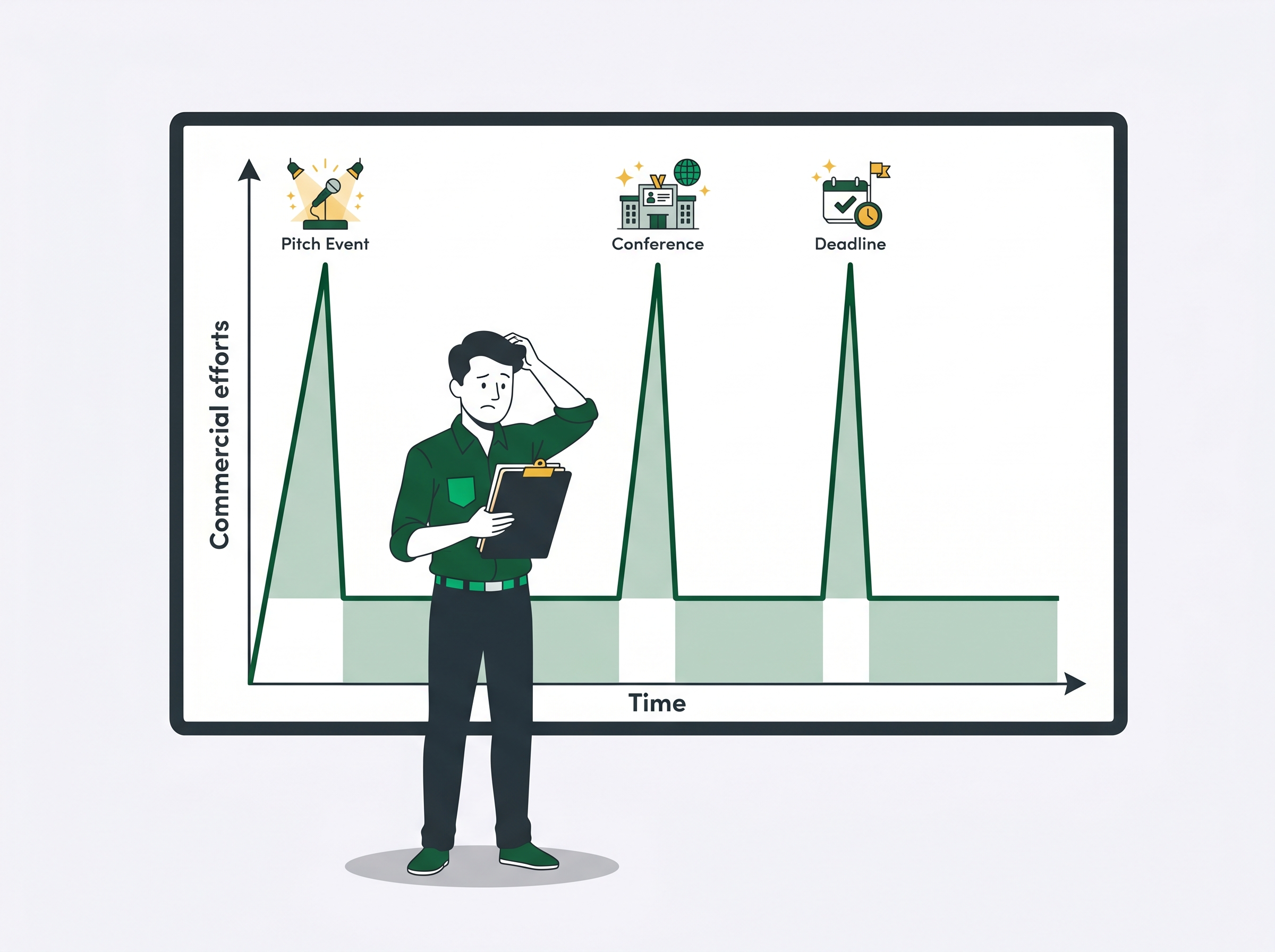
How your efforts feel when you only push
How your efforts feel when you only push.

To understand why startups end up on the circuitous route, you have to understand the default commercial playbook they operate from.

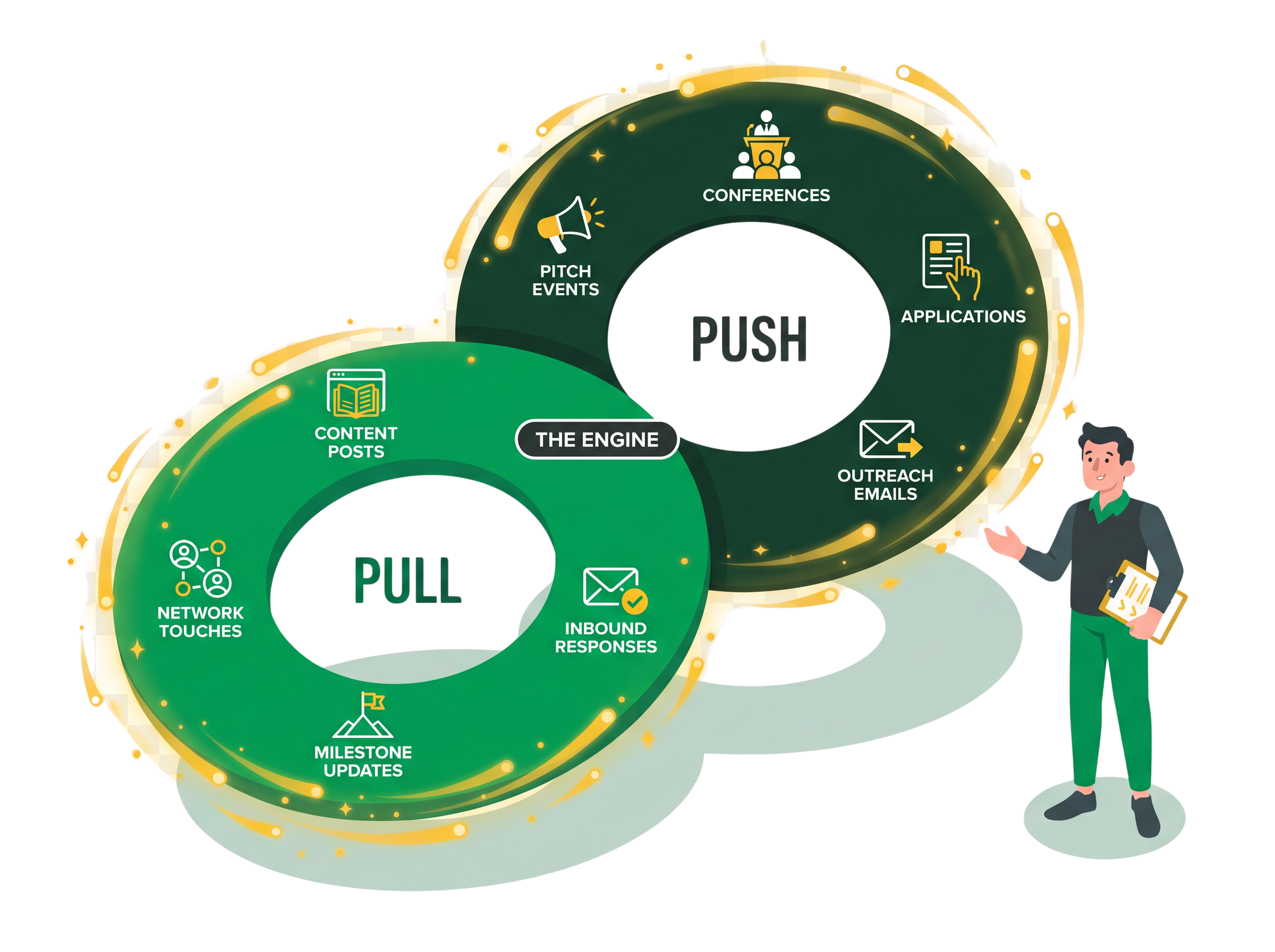
Most technology commercialization follows a linear logic: win the grant, complete the milestones, then go find a buyer. That sequence produces a very specific set of activities: grant applications, Phase II commercialization plans written for reviewers, pitch presentations at SBIR forums and demo events, conference networking, cold outreach to contacts in the founders' professional networks, and waiting for inbound interest that rarely arrives.

These are all push activities. They require the startup to go outward — to convince, to sell the vision, to ask for attention from people who haven't asked for it. And they share one critical characteristic:

Push efforts are short, choppy bursts. They require max effort and are hard to string together. This makes results harder to compound.

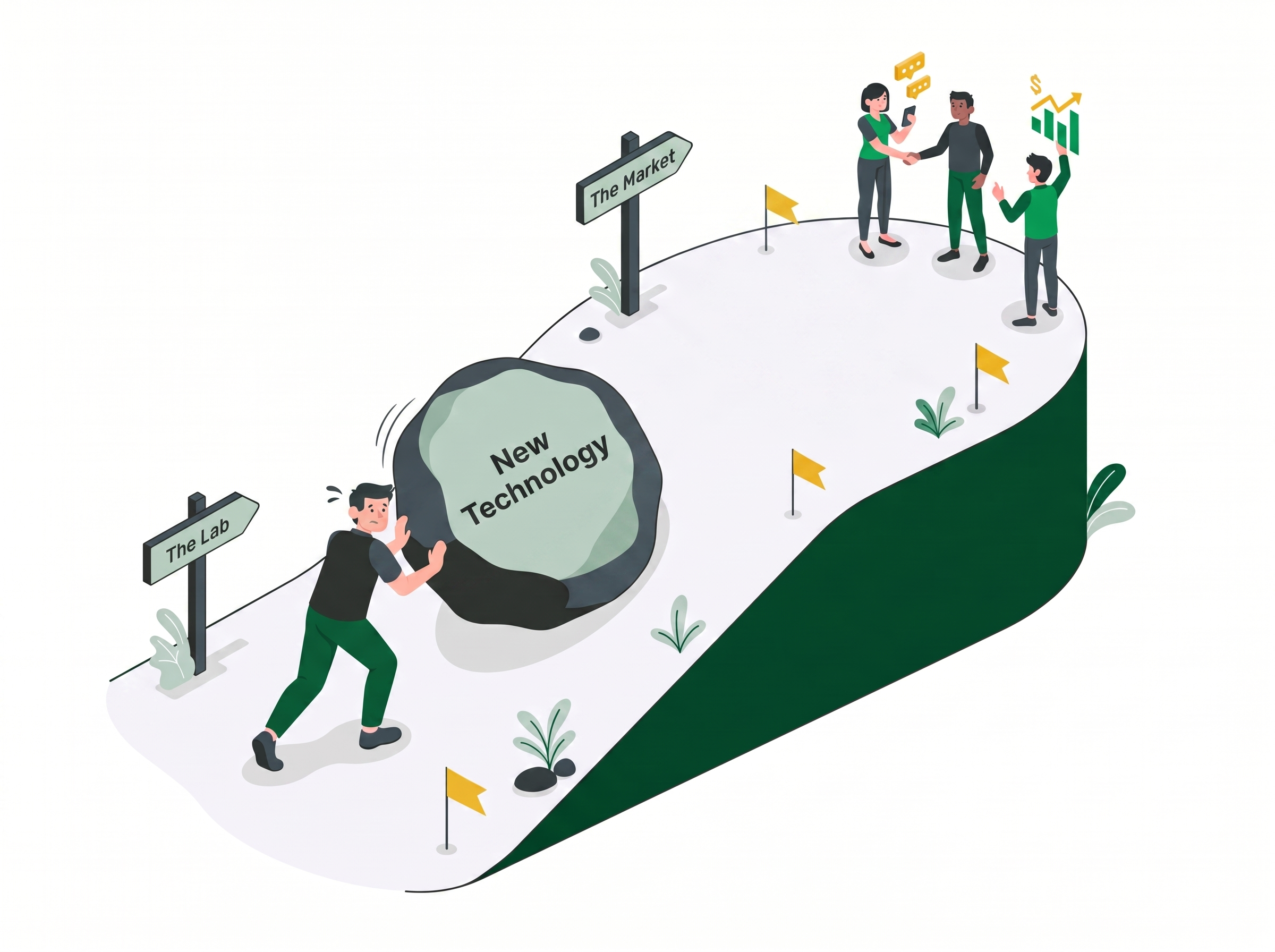
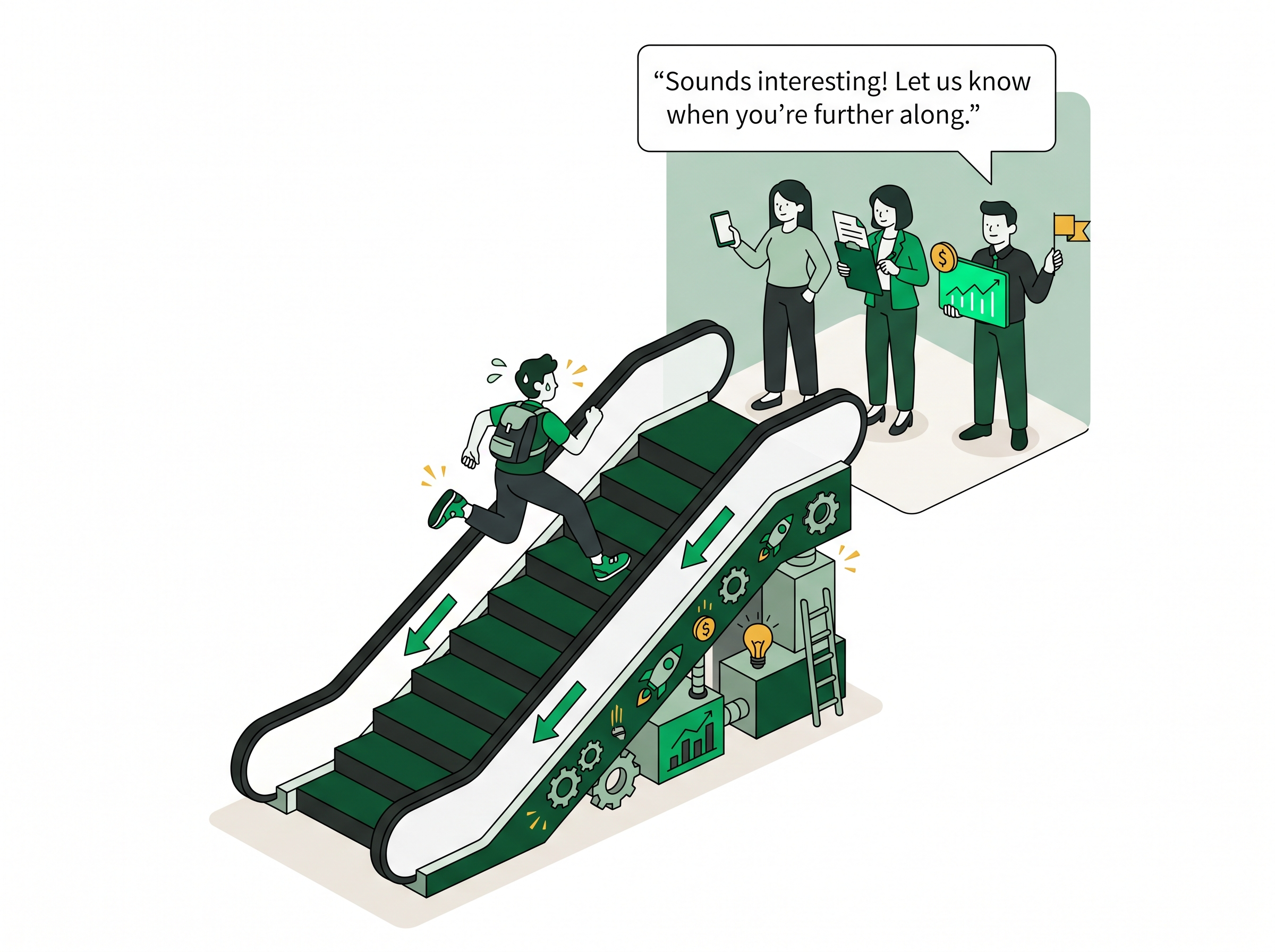
Push, in this way, is Sisyphean — destined to push the rock up the hill, with all your effort, only for it to roll back down.

The Constraint Trap

The push-only model doesn't just fail in theory. It collides with a set of specific, structural constraints that make it especially dangerous for the startups building physical technology. These are not personal failures. They are features of the environment.

1. You Cannot Iterate Quickly

Software startups test ideas in days. Hardware and materials startups test ideas in months or years. A single validation cycle for a new materials formulation, a power conversion device, or a biomedical implant can take 6 to 24 months. By the time you have commercially relevant results, the market has moved, the solicitation topics have changed, and the program manager you met at the SBIR forum has rotated to a new role.

2. Your Buyers Don't Respond to Standard Inbound

Government agencies, OEMs, and regulated-industry institutions make purchasing decisions on 12- to 36-month cycles, through procurement processes that require multiple layers of technical review and compliance. They don't convert through a landing page. The commercialization tools built for software — drip campaigns, inbound funnels, content marketing — are structurally incompatible with how these buyers actually operate.

3. Grant Compliance Consumes Commercialization Bandwidth

SBIR awardees aren't just building technology. They're managing milestone reporting, financial compliance, TPOC communications, and perpetual preparation for the next funding cycle. This overhead isn't optional. The bandwidth that should go to commercial relationship-building gets consumed by the administrative burden of being an awardee.

4. National Lab Access Doesn't Align with Startup Timelines

CRADAs average 110 days from submission to approval. DOE facility access for proprietary research can exceed $50,000. Startup survival timelines and national lab negotiation timelines are structurally incompatible — the window in which the founder needs the data frequently closes before the paperwork clears.

5. You Are Alone in a Very Specific Journey

Unlike software founders, technology startups have no playbooks built for their specific situation. No peer communities facing the same combination of constraints. No advisors who speak both fluent materials science and fluent go-to-market strategy.

This is not just an emotional problem. It is an operational one. When you don't know who to call, you don't call anyone. Decisions stall. Momentum dies. The question that needs a 20-minute conversation with someone who's been there sits unanswered for weeks — because there is no one who's been there.

Without a system designed for these specific constraints, commercialization becomes an afterthought squeezed into whatever time the grant cycle doesn't claim. The result: technically excellent startups with no commercial surface area. No way for the right people to find them, evaluate them, or pull them forward.

Chapter 08

The Myth of Sisyphus

The Myth of Sisyphus

In Greek mythology, Sisyphus was condemned to push a boulder up a hill for eternity — only to watch it roll back down each time he neared the summit.

The deep tech commercialization journey can feel the same way. Every grant cycle is another climb. The constraints pile up — technical reviews, proposal deadlines, milestone reports. Everyone around you seems focused elsewhere, and you're condemned to push the rock alone.

It doesn't have to be that way.

A Field Note

A Note on I-Corps

I-Corps is genuinely valuable. It introduces customer discovery discipline to scientists who have never thought about markets. It forces founders outside the building — a real mindset shift. Research shows 95% of I-Corps teams make at least one business model change; 66% make significant multi-component adjustments.

But I-Corps teaches customer discovery. It does not teach commercialization architecture.

It tells you who might want your product. It doesn't build the system for reaching them, building relationships with them, or converting those relationships into pilot programs, Phase III contracts, or investment conversations. The program is seven weeks. Technology commercialization timelines are measured in years. Founders leave I-Corps with better market intuition and no ongoing community, no accountability structure, and no commercialization infrastructure to build on.

Steve Blank, the founder of the I-Corps methodology, has said this directly:

“My experience with the handful of companies providing 'market insight' to grantees has been quite disappointing. It would be charitable to call it 'cut and paste' marketing. It's not worthy of basing any commercial business on.”— Steve Blank, founder of the I-Corps methodology

I-Corps is the starting gun, not the race. What follows is about what comes after the starting gun — the ongoing system the grant cycle never provides.

The Reframe: Push + Pull

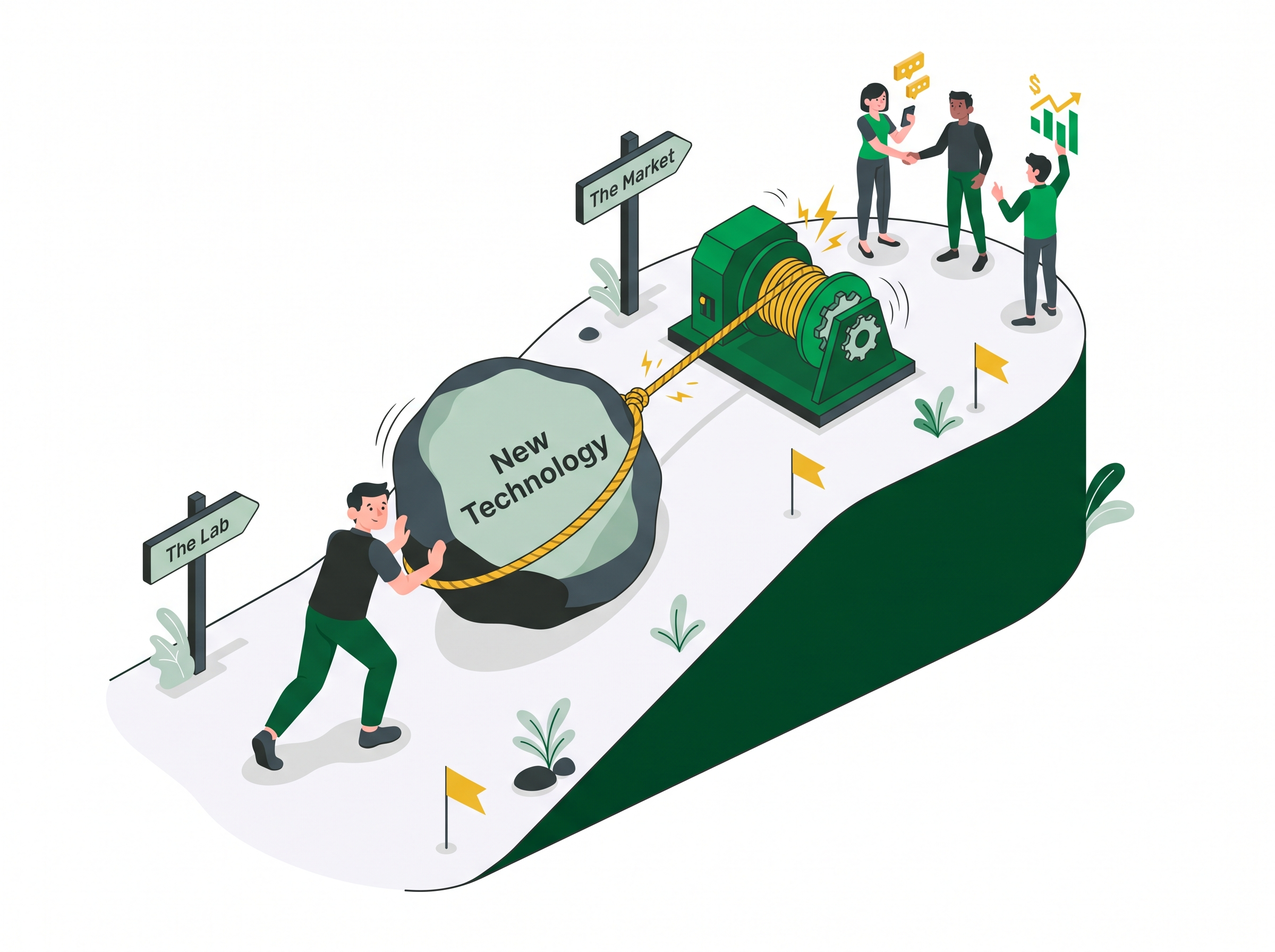
Same boulder, same hill, but now with a motorized winch
Same boulder. Same hill. But now with a motorized winch and an audience at the top.

The alternative isn't to abandon push. Push matters. Grant applications still matter. Conferences, direct outreach, agency relationships — all of it still matters. The shift is to add pull.

Pull is the structural complement to push. Where push requires going to the market and convincing it, pull brings the market to you. Where push is transactional, pull is structural. Where push depletes resources, pull generates momentum. Pull creates a channel to push information out to your network AND lets the market pull you forward. It works in both directions.

The Identity Shift

The push-to-pull transition isn't just a tactics change. It is an identity change. The push-only founder identity is: "I am a researcher doing commercialization as an afterthought." The research is the real work. The commercialization is the pitch deck assembled three weeks before the Phase II deadline.

Now you're Sisyphus — but with a motorized winch. Same boulder, with a motorized winch and an audience at the top. Steady, compounding commercial activity over time.

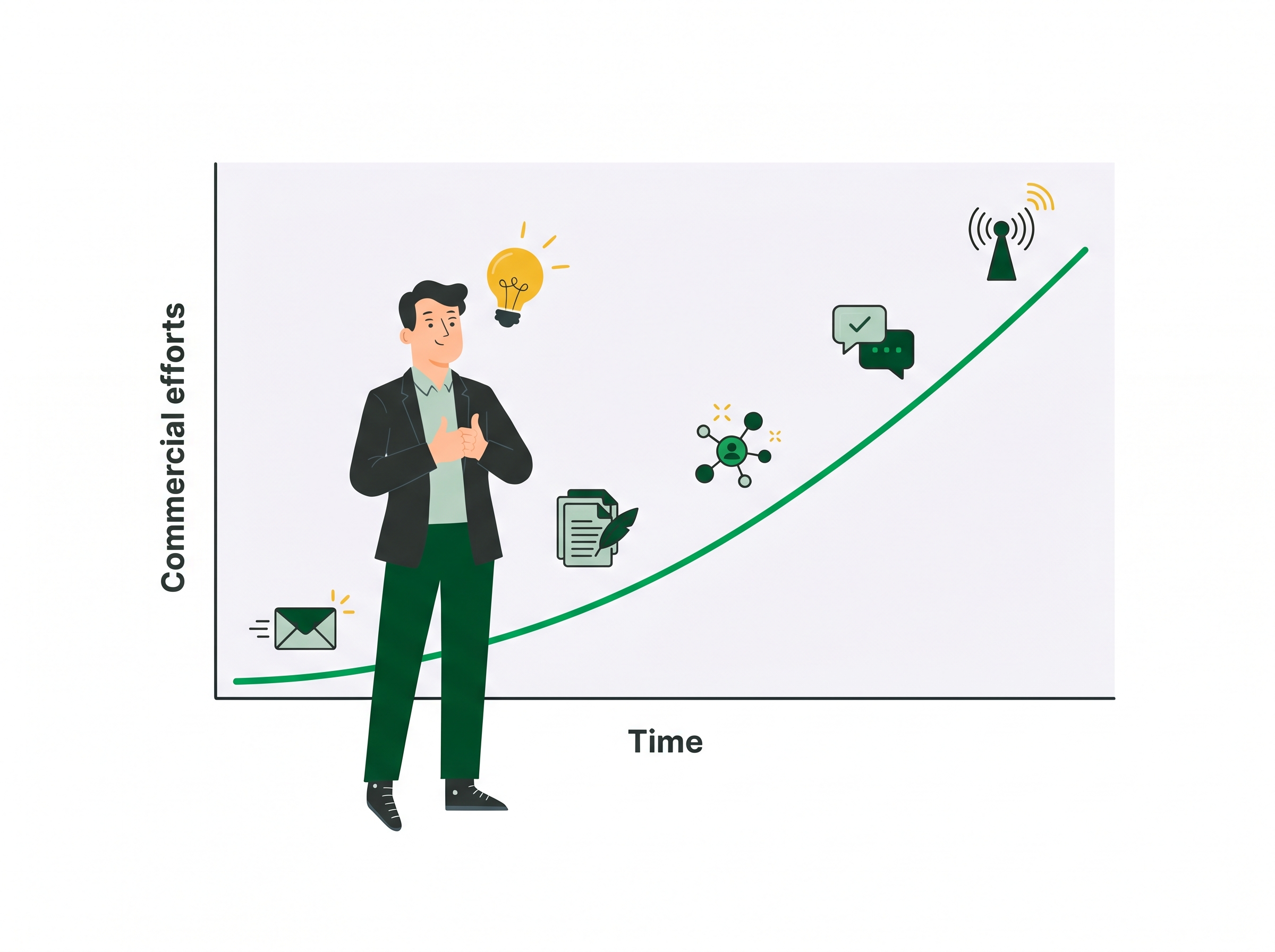
The pull-enabled identity is different. Instead of constant, all-out efforts that may or may not string together, a pull-enabled mindset directs you on the right path and lightens the load by tugging you in the right direction.

This reframe changes everything about how technical work relates to commercial work. Every milestone in the lab becomes a piece of commercial signal to share with the right people. Every data point becomes a reason to reach out to a TPOC contact, update a potential pilot partner, or give an investor something concrete to anchor a developing relationship.

The Two-Track System

The most important strategic insight in this guide is this: grant work and commercial work are not competing priorities. They are parallel tracks that fuel each other.

Technical milestones become content and credibility for the commercial network. Progress on Phase I feeds updates to OEM contacts, pilot partners, and investors who are building their understanding of the technology over months and years.

Commercial traction becomes evidence for grant applications. Pilot partnerships, industry letters of support, and demonstrated market interest are among the most compelling elements in a Phase II or Phase III application. The commercial work strengthens the grant work.

Progress in one is fuel for the other, creating a flywheel effect.

The goal is to use grant funding to drive forward technology capabilities or product development — ideally both simultaneously. And to use that progress to communicate traction to the commercial network. Conversely, use early market traction to demonstrate the capacity to meet grant solicitation needs. The two tracks run in parallel and reinforce each other at every stage.

You Always Have Something to Say

The most common objection to starting the commercial work early is: "We don't have anything to share yet. We're still years from market."

This is the wrong frame. Even at the earliest stage, a startup has something genuinely valuable to communicate. You discuss the problem you're solving — its scope, its cost, its impact on the people and organizations experiencing it. You describe your proposed approach and what makes it meaningfully different from existing alternatives.

Credibility comes from the depth of your problem analysis. Differentiation comes from your solution. The commercial conversation can start long before you have commercial results, because the right people — the ones who will eventually become your pilot partners, investors, and customers — care about the problem before they care about the product.

Commercialization effort should be smooth, continuous, and gradually increasing.

A Field Note

Sisyphus the Success Story

Sisyphus the success story

The story of making new technology doesn't have to be a Greek myth tragedy. It's hard, and it should be, like anything worth doing. But it doesn't mean we have to do it alone.

This one mindset shift — from push to pull — can help engage more people who can bring the technology to market sooner.

The Key Questions: Your Messaging Foundation

Before building a website, configuring an automation platform, or drafting a single piece of outreach, a startup needs to answer five foundational questions. These questions are the foundation of everything downstream: the website, the outreach sequences, the grant commercialization sections, the investor conversations, and the team's shared understanding of what the company is and why it exists.

It is tempting to skip this step, especially for more mature companies. Don't. Even for teams that have been operating for years, working through these questions together builds alignment, hones focus, and surfaces the messaging that feeds every downstream deliverable. The teams that do this well build better websites, write better proposals, and have more productive investor conversations — because everyone is telling the same story.

Work through these with the full founding team. Research the customers. Build their voice into the answers. The output is a structured messaging document that everything else draws from.

The output of these five questions is a structured messaging document — typically two to three pages — that captures your answers with enough specificity to be directly usable. This document is the input for everything in the four weeks that follow.

See Appendix A for the printable Key Questions Worksheet your team can work through together.

Question 1 of 5

Why does this problem exist?

The root cause. Your north star and your organizational purpose. A strong Why is compelling, specific, and connects to something larger than the product.

Prompts: What is the root cause of the problem your technology addresses — not a symptom, the underlying cause? What larger purpose does that root cause connect to (energy security, climate, supply-chain resilience, public health, national defense)? Why does this matter now — what makes the moment urgent for the people who would care most?
Example — EV Battery Startup: Global reliance on fossil fuels creates energy insecurity, climate consequences, and supply chains vulnerable to geopolitical disruption. Electrochemical energy storage is the enabling technology for a resilient, sustainable energy system — but current battery chemistry imposes cost, density, and cycle-life constraints that limit large-scale adoption.
Question 2 of 5

What are the current conditions on the ground?

The observable symptoms of the unsolved problem. What does the world look like when this goes unaddressed? These are facts your customers and partners already live with.

Prompts: What is observably broken right now — the day-to-day symptoms your target buyer/partner already recognizes? What evidence and data captures the scope and cost of the problem? How would your customer describe what they live with — in their own words?
Example — EV Battery Startup: Utility-scale storage projects are constrained by the $/kWh cost of lithium-ion at grid scale. EV adoption stalls in commercial fleet applications because current cycle-life economics don't pencil out. Grid operators can't integrate intermittent renewable capacity without storage that doesn't yet exist at the required cost point.
Question 3 of 5

What will you do differently?

Your differentiator. What does your approach make possible that current alternatives cannot? Anchor in technical specifics without overclaiming based on current TRL.

Prompts: What does your approach make possible that today's alternatives cannot — framed as commercial outcome, not just mechanism? What is currently proven at your TRL? What does the development roadmap unlock next? Where does the technical specificity connect to the commercial reality without losing either?
Example — EV Battery Startup: Our solid-state electrolyte formulation eliminates the thermal runaway risk of liquid lithium-ion while achieving 40% higher energy density at comparable cost. This enables commercial fleet vehicles and grid-scale storage applications that are currently uneconomical with existing chemistry.
Question 4 of 5

Who experiences this problem?

Be specific — not "the market" but the actual organizations and people with the problem. This exercise often surfaces multiple distinct segments; the messaging system can branch to address each.

Prompts: Which specific types of organizations have this problem? Name them concretely. Which roles inside those organizations feel it most in their daily work? Are there multiple distinct segments? List each — the messaging system can branch to each.
Example — EV Battery Startup: Commercial fleet operators (Class 8 trucking, port equipment, last-mile logistics) locked into diesel economics. Utility-scale renewable developers unable to close project finance without dispatchable storage. DOE and DOD procurement teams seeking domestically manufactured battery alternatives for energy security applications.
Question 5 of 5

How is this delivered as a business?

How do you deliver the differentiating solution to the affected parties in a way that is economically sustainable? Be specific about the commercialization pathway.

Prompts: What's the path between today's TRL and the first dollar of revenue? What comes first, then next? What's the Phase I/II model? The Phase III shift? The procurement pathway running in parallel? What's plausible and sequenced — not certain, but credible at each stage?
Example — EV Battery Startup: Phase I/II: licensing formulation IP to Tier 1 battery manufacturers for co-development. Phase III: direct supply agreements with commercial fleet OEMs and grid-scale integrators. Government procurement pathway via DOE and DOD supply chain programs running in parallel.

The Commercialization Engine

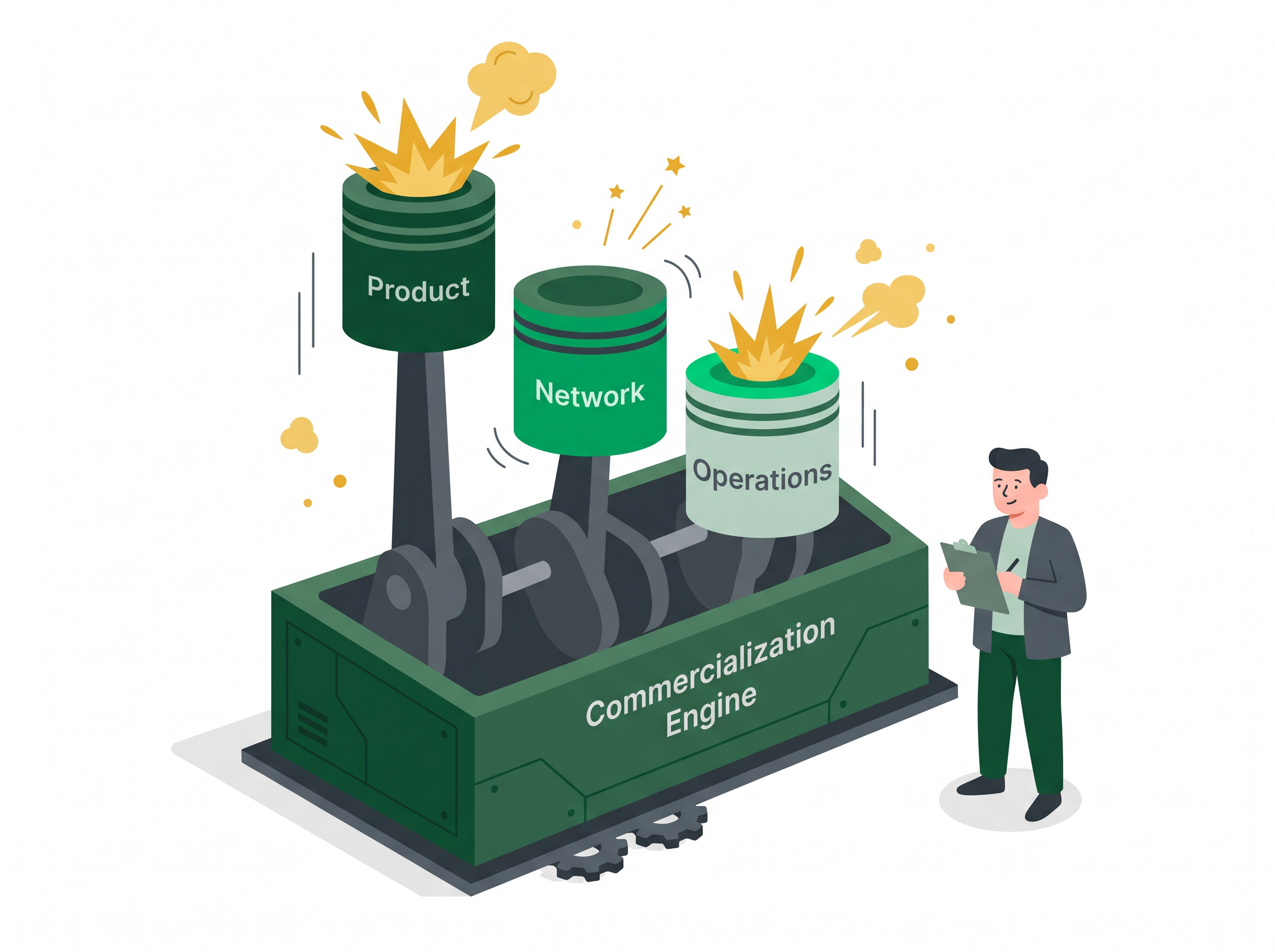
Three pistons firing
Three pistons firing — Product, Network, Operations.

Once the messaging foundation is in place, the commercialization engine is built from three integrated systems. Together, they move a startup from technical validation to commercial traction — with or without an active grant award, and without requiring a dedicated sales team or marketing background the founding team doesn't have.

System 1

The Product System

The Product System is how the startup's technology shows up to people who are not scientists. Most startups have excellent technical documentation — publications, patents, lab data. What they rarely have is market-facing positioning that answers the only question a non-scientist buyer actually cares about: what problem does this solve for me, and why is your approach meaningfully better than my current alternative?

The Product System builds the translation layer: a clear value proposition in the language of the problem, technology summary materials (whitepapers, technical briefs, application notes) usable in both commercial conversations and grant applications, a TRL-to-commercial milestone map that shows investors and pilot partners where the technology is and what the path to deployability looks like, and a market-facing web presence designed for the technical stakeholders who are evaluating the space.

System 2

The Curated Commercialization Network

This is where most commercialization guides go wrong. They import language from the software world — email lists, content funnels, lead generation — that has no application to how technology markets actually work. The customer system for a startup is not a sales funnel. It is a curated commercialization network.

The central challenge isn't finding customers per se. It's building relationships with all the people who help the startup march toward the market — long before those relationships are needed: pilot partners who provide real-world validation data citable in Phase II and Phase III applications; collaborators who extend technical credibility and open doors to facilities and expertise; investors who need 12–18 months of contact before they can commit; agency TPOCs and Program Managers whose priorities, timelines, and program interests need to be understood before the next proposal is submitted; OEM scouts and industry contacts evaluating emerging technologies on 12–36 month procurement cycles.

This network serves both commercialization and grant strategy simultaneously. Market traction evidence from pilot partnerships and industry relationships can be cited directly in Phase II and III applications.

What gets shared with this network is relationship capital, not marketing content: research milestone updates, technical summaries, pilot program invitations, and relevant industry news responses. The communication establishes credibility through problem depth and differentiates through solution progress.

System 3

The Operational System

The Operational System is what makes the first two systems run without consuming all available founder bandwidth. It includes a pipeline dashboard tracking the health of the commercialization network, automated touchpoints maintaining relationship presence between major milestones, a content calendar aligned to technical milestones so that lab achievements automatically generate reasons to reach out to the right people, and feedback mechanisms capturing market signal that feeds back into both the commercial strategy and the grant narrative.

The Operational System transforms the commercialization engine from a project into infrastructure. Projects get dropped when things get busy. Infrastructure runs.

The Four-Week Sprint

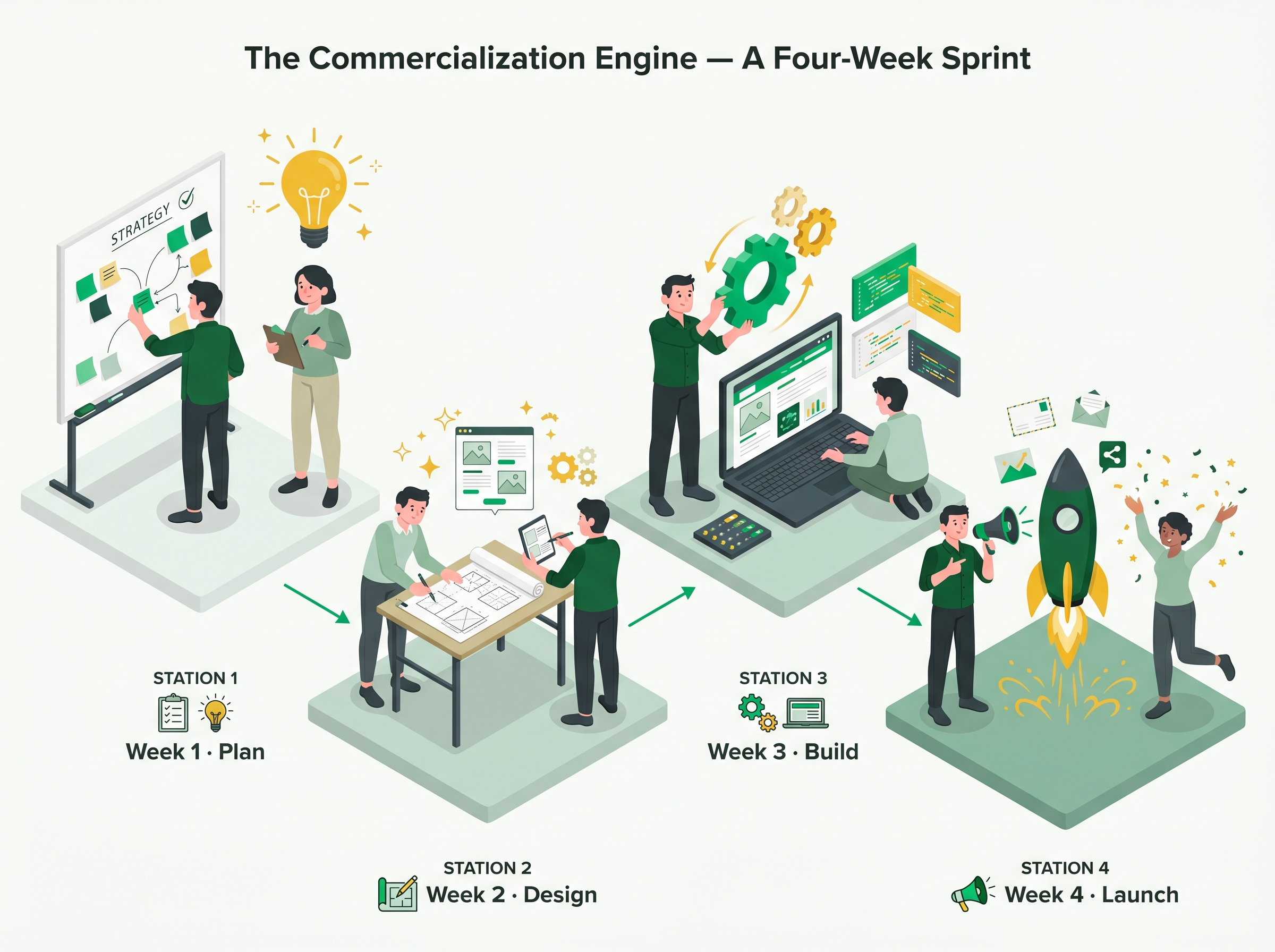
The Four-Week Sprint overview

The sprint doesn't get your technology to market. It builds the machine that will.

Four weeks to build it. Then it runs. The most common objection: "My technology takes years to commercialize. How does four weeks help?" That objection assumes the sprint is supposed to close a deal. It isn't. The sprint builds the commercialization infrastructure that will run for the months and years it takes to close the deal. Four weeks to build the engine. Then the engine runs.

The sprint is four weeks: planning, designing, building, and launching. Each week sets up the one after it — skip a step and you build the wrong thing, or launch into a void. The first two weeks aren't prep work; they're the architecture for everything that follows.

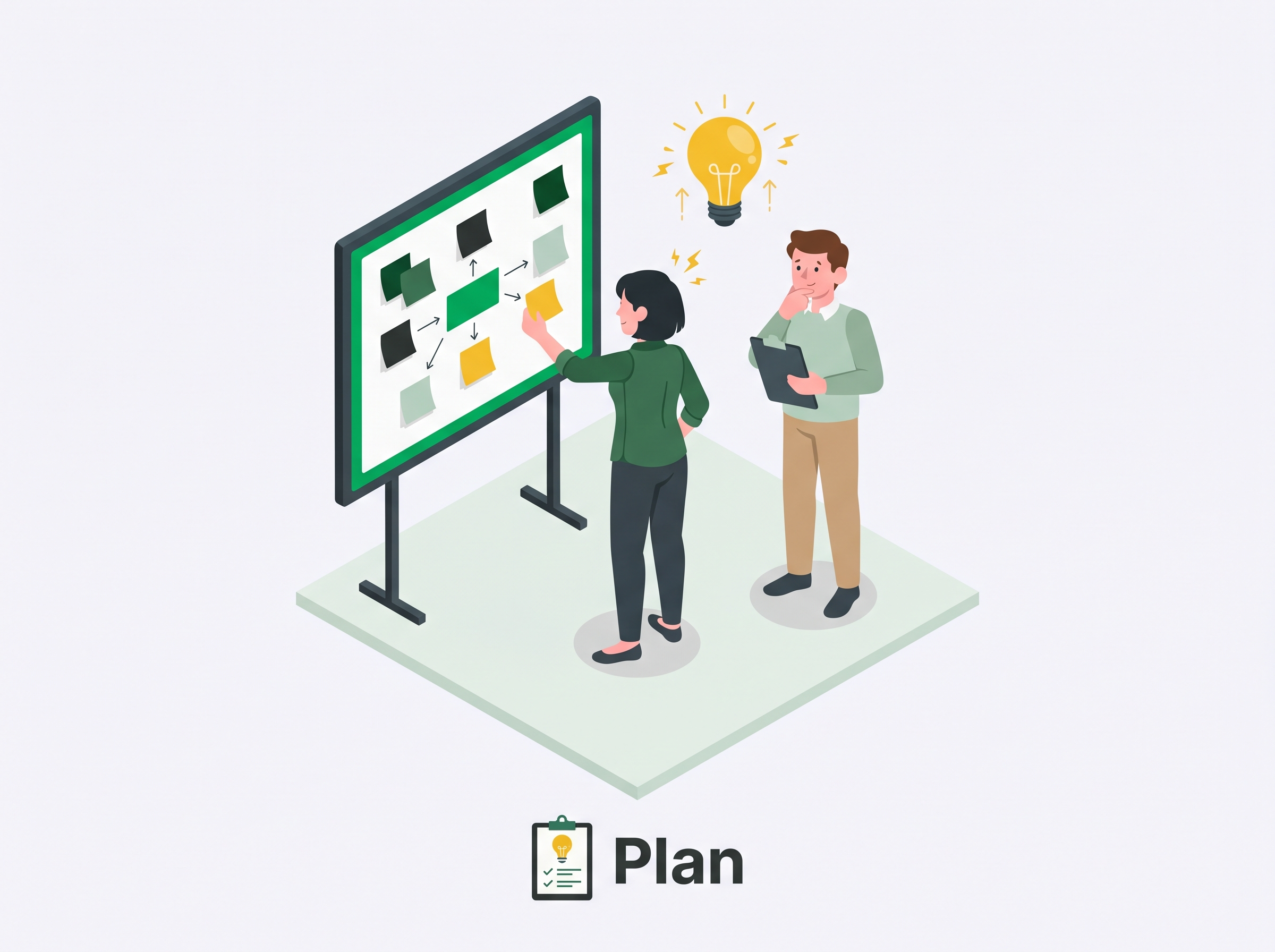
Week 1 — Foundation: The Key Questions and Messaging

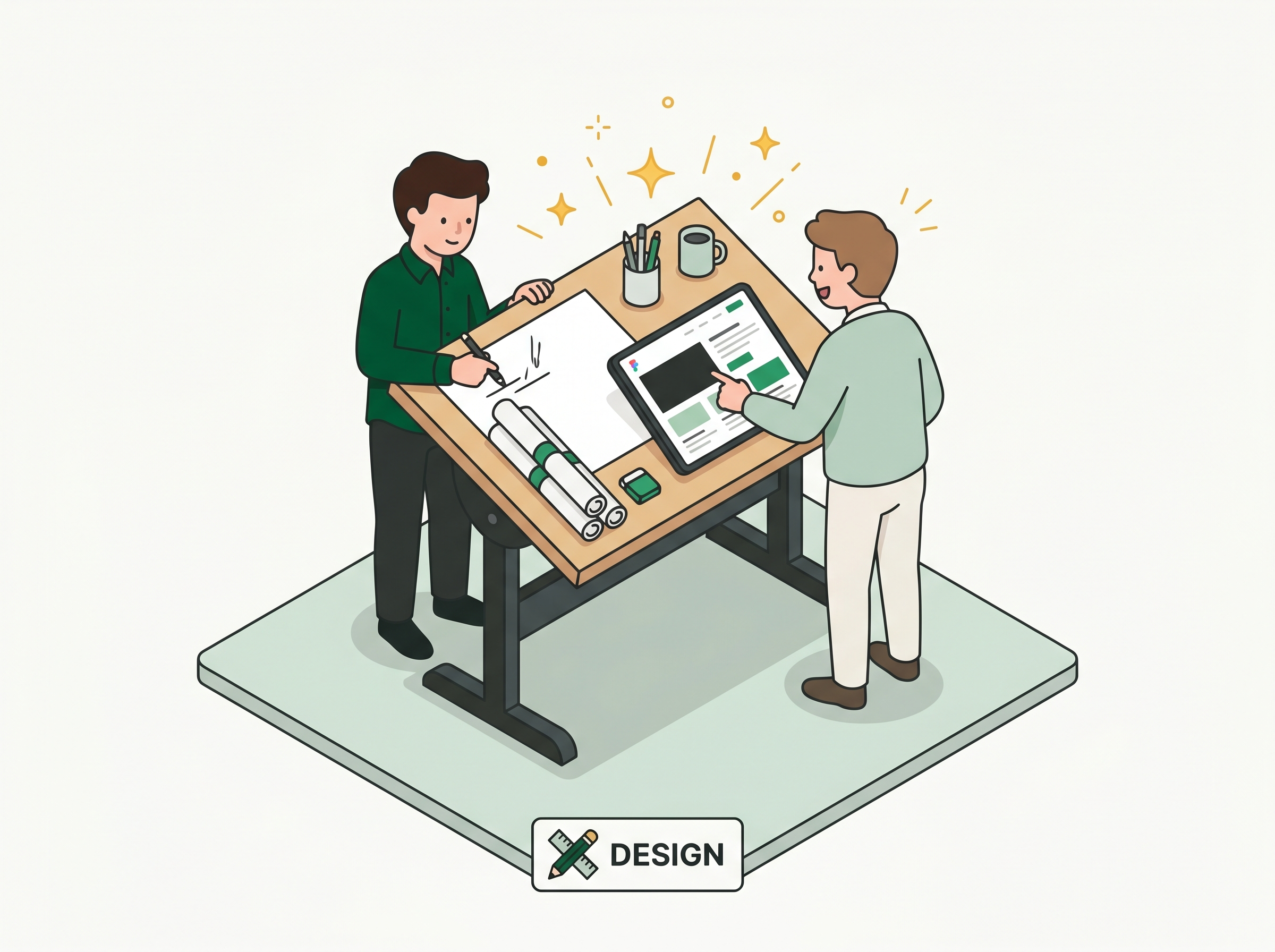
Week 1 illustration

Key Activities:

  • Work through the five Key Questions as a full team — Why, What (conditions), What (differentiator), Who, How
  • Research the customer segments; build their voice into the answers
  • Consider upstream and downstream from the primary customer — who else in the value chain experiences the problem?
  • Produce the structured messaging document that feeds all downstream deliverables
  • Define success metrics: what signals will tell us the system is working?
Outputs: Structured messaging document complete and team-aligned. Customer segments defined with specificity. Value proposition in market language (not TRL language). Success metrics established.

Week 1 is about alignment and direction. Before any tool is touched, the team shares a single story about the problem, the solution, and the people who need it. Everything in weeks 2 through 4 draws from this document.

Week 2 — Architecture: Diagrams Before You Build

Week 2 illustration

Key Activities:

  • Map the customer and contact journey for each segment: What path do you want a pilot partner to take from first exposure to engaged relationship? An investor? An agency TPOC?
  • Build the messaging map: What does each type of contact read or hear at each stage of their journey?
  • Diagram the automation flows: What does each interaction trigger? A whitepaper download → what sequence fires? A cold outreach reply → what happens next?
  • Create a Figma Make wireframe to map the messaging across website pages before any styling decisions are made
  • Use FigJam for the journey maps and automation flow diagrams — these are shareable, collaborative, and become permanent documentation
Outputs: Customer journey maps for each contact type (in FigJam). Messaging map showing what each audience hears at each stage. Automation flow diagrams for all key interaction triggers (in FigJam). Figma Make website wireframe with messaging mapped across pages.

Week 2 feels like more planning when you want to be building — but this is the designing phase, and design is an integral step of building. The diagrams produced this week are the blueprints for Week 3. Skip them, and you build the wrong thing, then rebuild it. The Figma Make wireframe is the highest-leverage artifact: it shows how the messaging flows across the website before any development time is invested in styling.

Week 3 — Build: Website and Automation Infrastructure

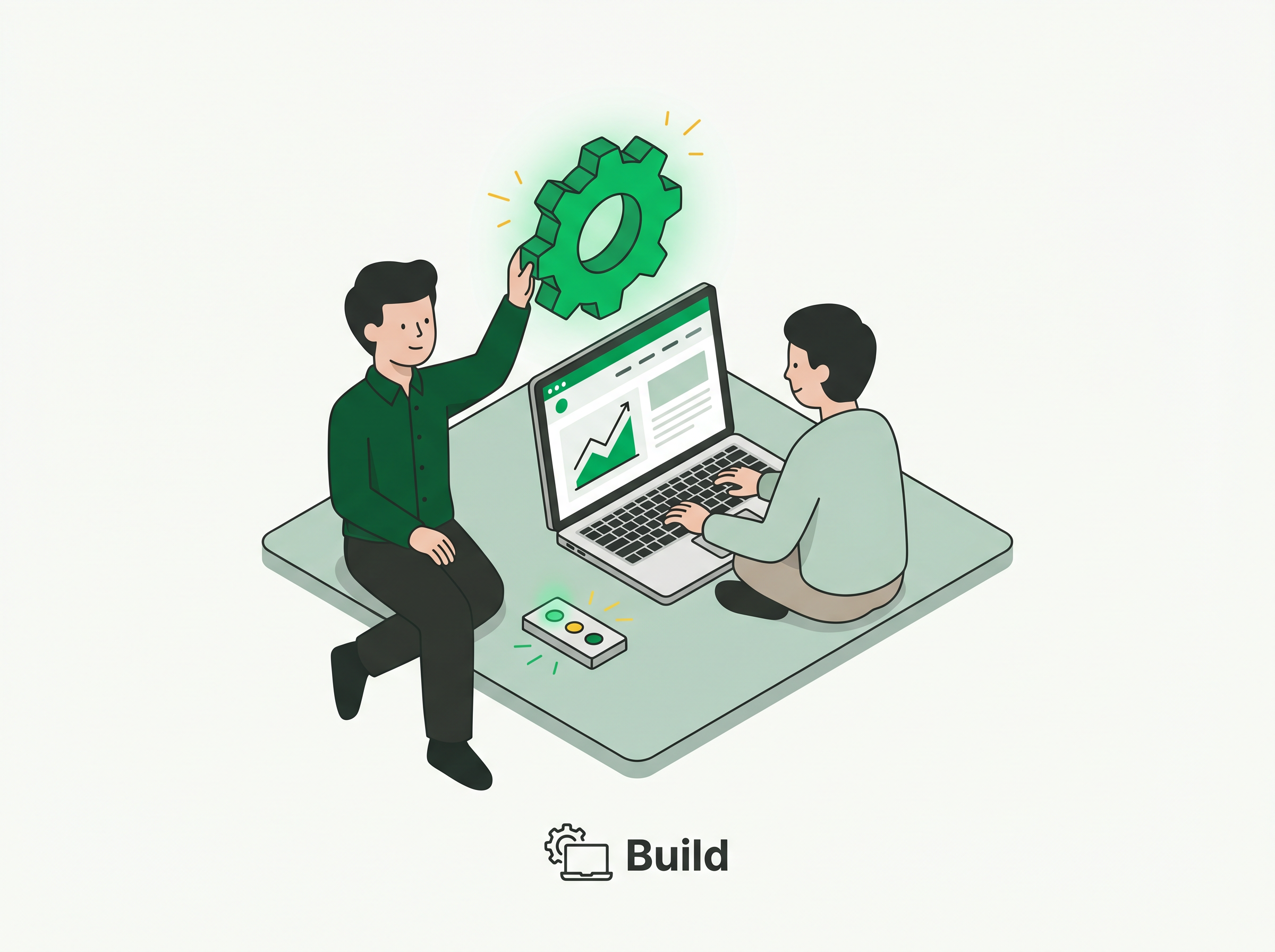
Week 3 illustration

Key Activities:

  • Build the website from the Week 1 messaging and Week 2 wireframe — Framer or WordPress recommended for their ability to push contact data to a customized backend
  • Implement lead capture forms on the appropriate pages, connected to the automation platform
  • Configure the contact database in GoHighLevel: segments, data tags, and contact organization based on the Week 2 diagrams
  • Build the automated outreach sequences from the Week 2 flow diagrams — pilot partner cadence, investor nurture, agency relationship touchpoints
  • For broader cold outreach capacity, additional inboxes can be added to extend reach without overloading primary domains
Outputs: Website live with messaging implemented and lead capture active. GoHighLevel configured: segments, tags, and contact structure in place. Automated sequences built and tested against the Week 2 diagrams. Cold outreach infrastructure ready to activate.

Week 3 is implementation from blueprints. The decisions about what to build were made in Week 2. Week 3 is about execution fidelity — building what was designed, not improvising. GoHighLevel is the recommended platform because it merges CRM, email outreach, and automation into one system, handling the administrative overhead that would otherwise require multiple tools and manual coordination.

Week 4 — Activate: Shareable Assets and Launch

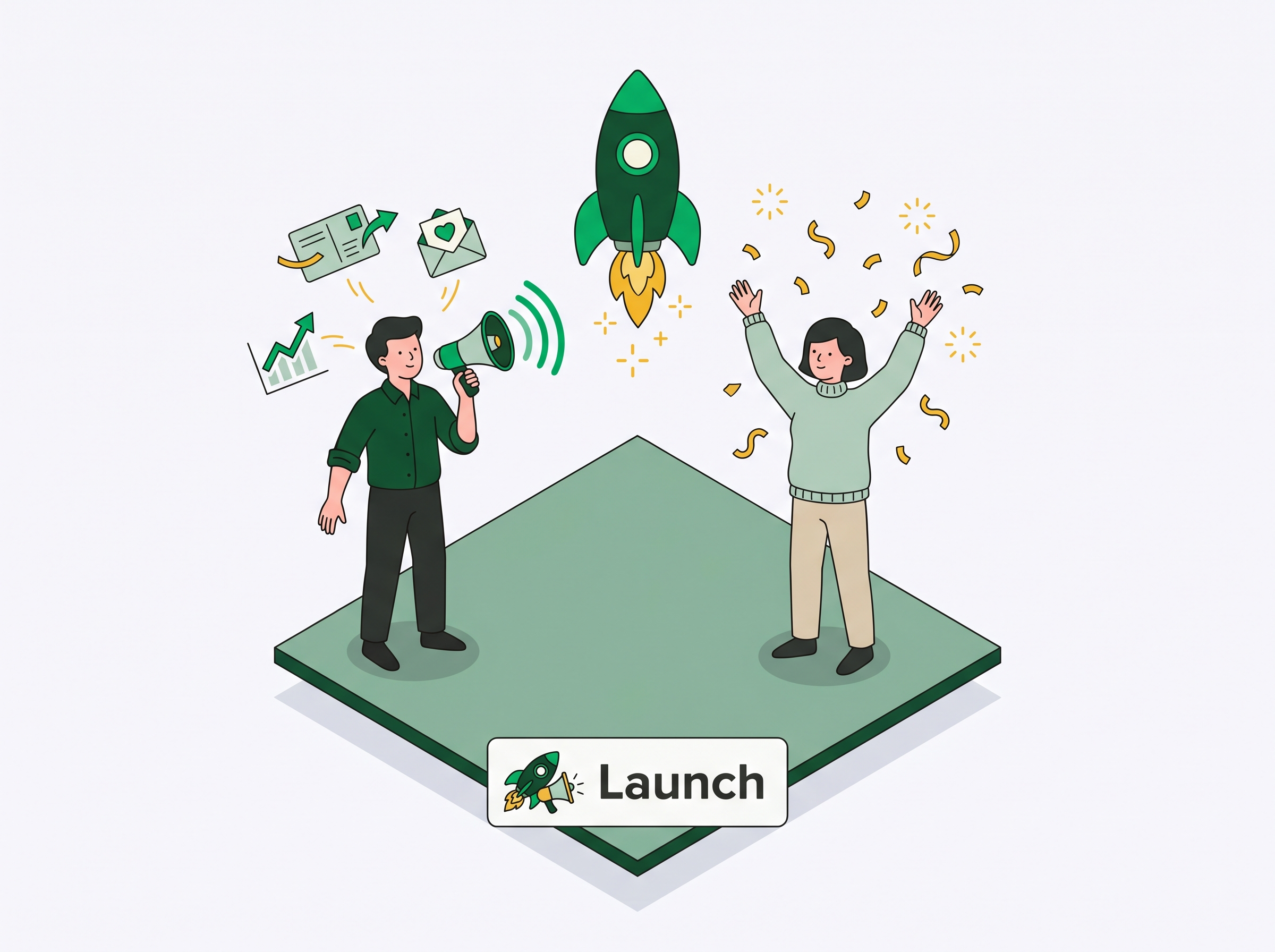
Week 4 illustration

Key Activities:

  • Create the shareable assets that act as fishing line — content cast into the world that reels in pilot partners, investors, and industry contacts over time
  • Place whitepapers and technical documents behind lead capture gates
  • Launch initial cold outreach to the curated contact list
  • Establish the content calendar: blog posts, social media, and email cadence
  • Schedule the first month of outreach; document the process for ongoing operation
Outputs: Whitepapers and technical content behind lead capture gates. Cold outreach launched to the initial curated network. Content calendar established with first month scheduled. Process documentation complete for ongoing operation.

Week 4 is activation. You map out the content you'll share over the next quarter and produce the first batch — especially the evergreen pieces (problem-analysis posts, technology summaries, pilot invitations) that will keep working long after they're published. The right people start hearing from the startup consistently, for the first time, with a coherent narrative. The point is not immediate conversion. The point is a system that communicates the startup's status, capabilities, and direction consistently over time — measurable, iterable, and independent of the grant cycle.

Don't delegate this to an intern. The instinct is to hand content off to whoever "understands social media." Resist it. This is the pillar of the business that communicates its purpose and value to every pilot partner, investor, and agency contact who encounters you. The voice has to be the founders' voice. Templates and cadence can be delegated; the message cannot.

Most startups operate with an ad hoc commercialization strategy. Ad hoc is harder to measure and harder to improve. A system with a defined cadence can be evaluated, adjusted, and compounded. Instead of ad hoc grant chasing with no commercial momentum, the startup now has a machine running in parallel: pushing technology and products forward, pulling in funding and customers.

Grant writing and technical development are hard enough. An efficient commercialization engine isn't a bonus. It's table stakes for startups that survive and thrive.

What Comes Next

What comes next

If you've read this far, you likely recognized your startup somewhere in these pages. The funding dependency. The circuitous route. The constraint trap. The isolation. And now, hopefully, a clearer picture of the system that changes the equation.

Before we describe the paths forward, notice what just happened in this guide. We practiced what we preach.

We opened by establishing credibility through problem analysis — diagnosing the funding dependency, the circuitous route, the acceleration-fragility paradox, and the constraint trap with specificity. We differentiated with a solution: the Push + Pull framework, the Two-Track System, and the four-week commercialization engine. And we communicated a clear path forward. That is exactly what this guide asks you to do. Define the problem deeply. Differentiate with your solution. Communicate the path. This ebook is itself a demonstration of the methodology.

The path forward comes down to one question: how do you want to build it?

Option 1: The Collaborative Sprint

A four-week engagement where our team works alongside yours to build the commercialization engine together. Each week, we walk through the deliverables with you, provide direct feedback on your messaging, diagrams, and system configuration, and help you finish. We bring the commercialization systems expertise and the technology market knowledge. You bring the technical depth and the domain expertise. By the end of Week 4, the curated network is built, the pipeline is live, and your team knows how to operate it.

This is not a consulting engagement that produces a strategy document. It produces a working system, built with you.

Option 2: The Coaching Community

This is not a course. It is an ongoing peer community of technology founders navigating the same SBIR ecosystem, the same hardware development cycles, and the same commercial constraints — supported by experienced guides who speak both technical and commercial fluency.

What the community provides: Structured peer cohorts organized around SBIR phase and technology domain. Expert office hours: SBIR strategy, BD, national lab navigation, government procurement, investor storytelling. Peer accountability structure — the kind technology founders have nowhere else. A knowledge base built from founders who have navigated CRADAs, Phase II transitions, OEM pilots, and DOD procurement — institutional knowledge that doesn't exist anywhere else. Accessible monthly pricing. No equity. No per-project consulting fees. The Constraint Trap section named isolation as an operational problem. When you don't know who to call, you don't call anyone. The community is the answer.

Option 3: Done for You

For startups that need the commercialization system but cannot carve out the bandwidth to build it, we offer full-service delivery. We begin with a short onboarding call to understand the nature of the business and the current status and capabilities of the technology. From there, we handle everything.

What we deliver: a completed messaging scaffold system — easy to update and manage as the technology and commercial narrative evolve. Figma boards with customer journey maps and automation flow diagrams, documented and ready to hand to any future team member or contractor. A completed website with messaging implemented, lead capture active, and the content structure in place. Outreach infrastructure fully configured: contact database, segments, automated sequences, and initial content calendar ready to activate.

You get the engine without the project management overhead. Your team is handed a running system.

The Evidence for Doing This

A peer-reviewed study in Research Policy found that mentoring program participation was statistically associated with a $18.5 million increase in funding raised (p=0.001). The financial case for structured support is not just intuitive — it is empirically demonstrated.

The grant system will have good years and bad years. Solicitation topics will change. Agency priorities will shift. Programs will lapse and be reauthorized. AI will keep accelerating the discovery of new commercial opportunities. None of that changes if you have infrastructure that runs independently of any single source of validation.

Push technology and products forward. Pull in funding and customers. Build the system around the Why and the differentiating What. Everything else acts as a catalyst to that.

The best time to build your commercialization engine was before you needed it. The second best time is now.

Ready to build? catalyzingconcepts.com | ben@catalyzingconcepts.com

Choose how to build your commercialization engine.

Every path starts with the same foundation — a messaging system, a curated network, and the operational infrastructure to run it. The difference is how much of the build you take on alone.

FREE · DO IT YOURSELF
🛠️

Build It Yourself

  • Key Questions Worksheet
  • Website Build Checklist
  • Four-Week Sprint Plan
  • GoHighLevel Setup Guide
  • Content Calendar Template
★ Most Popular
COLLABORATIVE SPRINT

Build It Together

  • Complete messaging system
  • Market-facing website, built and live
  • GoHighLevel backend fully configured
  • Custom AI tools & agents for your team
  • Team training included
  • 2 months Membership included
See What’s Included →
DONE FOR YOU
🚀

Built For You

  • Complete messaging system
  • Market-facing website, built and live
  • Full GoHighLevel infrastructure
  • Custom AI toolkit, configured
  • Full documentation & handover session
  • 2 months Membership included
See What’s Included →

Key Questions Worksheet

Work through these five questions with your full founding team before building anything else. Capture your answers with specificity — not aspirational language, but the most accurate description you can currently give. This document is the input for your website, your outreach, your grant commercialization sections, and every investor conversation you have.

Recommended: set aside a 2-hour working session. Bring your team, a whiteboard or FigJam board, and any customer research or market data you have. Don't try to make the answers perfect — make them honest.

Question 1 of 5

Why does this problem exist?

Global reliance on fossil fuels creates energy insecurity, climate consequences, and supply chains vulnerable to geopolitical disruption. Electrochemical energy storage is the enabling technology for a resilient, sustainable energy system — but current chemistry imposes cost, density, and cycle-life constraints that limit large-scale adoption.
Question 2 of 5

What are the current conditions on the ground?

Utility-scale storage projects are constrained by $/kWh cost at grid scale. EV adoption stalls in commercial fleet applications because current cycle-life economics don't pencil out. Grid operators cannot integrate intermittent renewable capacity without storage that doesn't yet exist at the required cost point.
Question 3 of 5

What will you do differently?

Our solid-state electrolyte formulation eliminates thermal runaway risk while achieving 40% higher energy density at comparable cost — enabling commercial fleet and grid-scale applications currently uneconomical with existing chemistry.
Question 4 of 5

Who experiences this problem?

Commercial fleet operators (Class 8 trucking, port equipment). Utility-scale renewable developers unable to close project finance. DOE and DOD procurement teams seeking domestic battery alternatives for energy security applications.
Question 5 of 5

How is this delivered as a business?

Phase I/II: licensing IP to Tier 1 manufacturers for co-development. Phase III: direct supply agreements with fleet OEMs and grid-scale integrators. Government procurement pathway via DOE and DOD supply chain programs in parallel.

Notes / Additional Segments

Website Build Checklist

Your website is the front door of your commercialization network — not a corporate brochure, but the place where pilot partners, investors, agency contacts, and OEM scouts can find you, understand what you do, and take a first step. Build it from your Week 1 messaging document and Week 2 wireframe.

Recommended tools: Framer (fast, design-forward, strong CMS capabilities) or WordPress (flexible, widely supported, deep backend integration options). Either can be connected to GoHighLevel to push contact data from form fills into your automation infrastructure.

Pages to Build

Home Page

  • Lead with the problem (Why + What conditions) — not your technology
  • One-sentence value proposition above the fold
  • Brief solution description — what you do differently
  • Clear call to action: whitepaper download, newsletter signup, or contact form
  • Lead capture form connected to GoHighLevel pipeline

Problem / Why Page

  • Deep treatment of the problem — scope, cost, and consequence
  • Data and evidence to establish credibility
  • Who experiences this problem (your target segments)
  • Why existing alternatives fall short
  • Lead capture: "Stay updated on our research" or whitepaper download

Technology / Solution Page

  • Your differentiating approach explained in accessible language
  • TRL-to-commercial milestone map or development roadmap
  • Technical summary document available for download (gated: requires contact info)
  • Pilot program invitation or collaboration inquiry form

About / Team

  • Team credentials with emphasis on technical depth and relevant domain experience
  • Mission statement derived from your Why
  • Funding history and current development stage

Contact / Get Involved

  • Distinct paths for different contact types: pilot partner, investor, press/media
  • All forms connected to the GoHighLevel pipeline with appropriate tagging

Lead Capture Requirements

  • Every page has at least one lead capture mechanism
  • Gated assets require name, email, and organization at minimum
  • Forms tag contacts by page of origin in GoHighLevel — this is how you know what they were interested in
  • Test every form submission end-to-end before launch: fill the form — confirm the contact appears in GoHighLevel with the correct tag — confirm the correct automation fires

Technical Setup Checklist

Before you choose a website builder, you need to know what's underneath the website. These items are foundational to the tech stack that powers the Pull arm of your engine — and most founders don't have clean answers to all of them.

  • Domain registrar access confirmed
  • DNS access confirmed — ability to add records for email auth and website
  • Inbox provider and MX records documented
  • Website CMS selected (Framer or WordPress recommended)
  • GoHighLevel account active and configured

If the answer is "I custom-coded it myself" — start over. Cool, techy, and a trap. Time to stop playing with business toys and pick up business tools. Any modern web builder works: Squarespace, Wix, Webflow, all fine. But for the Pull engine specifically, you want a builder that makes adding pages, editing copy, and posting new content easy.

Our preference: Framer or WordPress. Framer — fast, design-forward, with strong CMS capabilities. Best when design quality matters, you want fast iteration on layout, and your backend needs are standard. WordPress — flexible, widely supported, deep plugin ecosystem. Best when you need integrations, your team already has WordPress experience, or you anticipate complex content management over time. Either connects to GoHighLevel via webhook or Zapier for form-to-CRM data flow.

GoHighLevel Automation Setup

GoHighLevel merges CRM, email outreach, deal pipeline, and automation into one platform — the recommended tool for managing the commercialization network. This checklist covers the core configuration for a functioning system. This is not a tutorial; it is a reference list for what needs to be built.

Note: For high-volume cold outreach beyond your primary domain's safe send limits, additional sending inboxes can be configured in GoHighLevel. This extends reach without risking your primary domain's deliverability.

Contact Segments to Create

  • Potential Customers
  • Pilot Partners (current and prospective)
  • Investors (angels, seed, deeptech-focused VCs)
  • Agency Contacts (TPOCs, program managers, agency BD)
  • OEM / Industry Contacts (corporate scouts, technical evaluators, procurement)
  • Collaborators (university labs, national lab partners, co-investigators)
  • Cold Outreach (move to relevant segment on response)

Data Tags to Configure

  • Technology domain (e.g., energy storage, advanced materials, medtech, defense)
  • Lead source (e.g., whitepaper download, website form, cold outreach, conference)
  • Engagement stage (e.g., new contact, first response, active conversation, meeting booked)
  • SBIR relevance (e.g., Phase II letter of support, TPOC relationship, Phase III pathway)
  • Geographic region if relevant to pilot programs or regulatory pathways

Automated Sequences to Build

Whitepaper / Gated Content Download Sequence

  • Trigger: form submission on gated asset page
  • Email 1 (immediate): deliver content + brief intro to the startup and the problem
  • Email 2 (Day 3): follow-up with related context or a second resource
  • Email 3 (Day 7): direct outreach — is this relevant to what you're working on?

Pilot Partner Nurture Sequence

  • Trigger: contact tagged as Pilot Partner (prospective)
  • Cadence: milestone update every 4–6 weeks
  • Pilot program invitation when relevant milestone is reached
  • Goal: maintain presence over 6–12 month horizon

Investor Nurture Sequence

  • Trigger: contact tagged as Investor
  • Cadence: milestone update monthly
  • Direct meeting request at 3 and 6 month marks
  • Goal: 12–18 month relationship development before formal raise

Cold Outreach Sequence

  • Trigger: manual enrollment for targeted lists
  • Email 1: problem-focused intro (no ask, establish relevance)
  • Email 2 (Day 4): brief on differentiator
  • Email 3 (Day 9): low-friction ask (15-minute call, whitepaper download)
  • Move responders to appropriate segment; remove non-responders after completion

First Five Automations to Configure

  • Form fill → contact created in GoHighLevel with source tag
  • Whitepaper download → content delivery sequence enrolled
  • Investor tag applied → investor nurture sequence enrolled
  • Pilot Partner tag applied → pilot nurture sequence enrolled
  • Meeting booked → confirmation sent + contact moved to "Active Conversation"

Content Types and Publishing Calendar

A consistent content cadence is what separates a commercialization system from an ad hoc strategy. The goal is not high volume — it is reliable signal. The right people should hear from you consistently, with content that is genuinely useful to them. Adapt this calendar to your development cycle; don't follow it rigidly.

Content Categories

Milestone Updates

A brief narrative update on technical progress — what was achieved, what it enables, what comes next.

Format: 200–400 word email or blog post, also shareable on LinkedIn.
Audience: Full commercialization network.
When: Every time a meaningful milestone is reached, regardless of calendar.

Technical Summaries and Whitepapers

A deeper treatment of the problem, the approach, or the performance data. Establishes credibility and differentiates.

Format: 1,000–3,000 word document with figures; PDF via gated download.
Audience: Pilot partners, investors, agency contacts.
When: Quarterly, or when a significant validation result warrants a standalone document.

Problem Analysis Content

Content that goes deep on the problem — its scope, its cost, the reasons existing solutions fall short. This is your credibility-building content.

Format: Blog post or LinkedIn article, 500–1,000 words.
Audience: Anyone in the problem space — good for discovery.
When: Monthly.

Pilot Program Invitations

A direct, structured invitation to potential pilot partners to engage with the technology at low risk.

Format: Direct email to targeted contacts, with a supporting one-pager.
Audience: Prospective pilot partners only.
When: When a relevant milestone makes a pilot feasible; typically once or twice per phase.

Industry and Agency News Responses

A brief response to a relevant development in your target industry or agency landscape. Demonstrates that you track the ecosystem, not just the lab.

Format: Short LinkedIn post or email to relevant contacts, 100–300 words.
Audience: Agency contacts, industry contacts.
When: As relevant events occur.

Standard Publishing Cadence

  • Weekly: 2 social media posts (LinkedIn) — rotate between problem analysis, milestone updates, and industry responses
  • Monthly: 1 email to full commercialization network — milestone update or problem analysis piece
  • Quarterly: 1 whitepaper or technical summary via gated download
  • As needed: Milestone updates + pilot program invitations

How to Use This Calendar

  1. Map your technical milestones for the next 6 months. Each milestone becomes a milestone update email and a social post.
  2. Identify one problem area where you can go deep. Write the first problem analysis piece in Week 4 of the sprint.
  3. Set a quarterly reminder to produce a whitepaper. Block the time now.
  4. Review the calendar monthly: did the content go out? What responses did it generate? Adjust the next month based on what worked.

Consistency over time is what builds the commercialization network. The first three months will feel like shouting into a void. By month six, the right people will be reading, responding, and reaching out. By month twelve, the system will be generating inbound you didn't manufacture.

This is the machine running. Your job is to keep feeding it.